
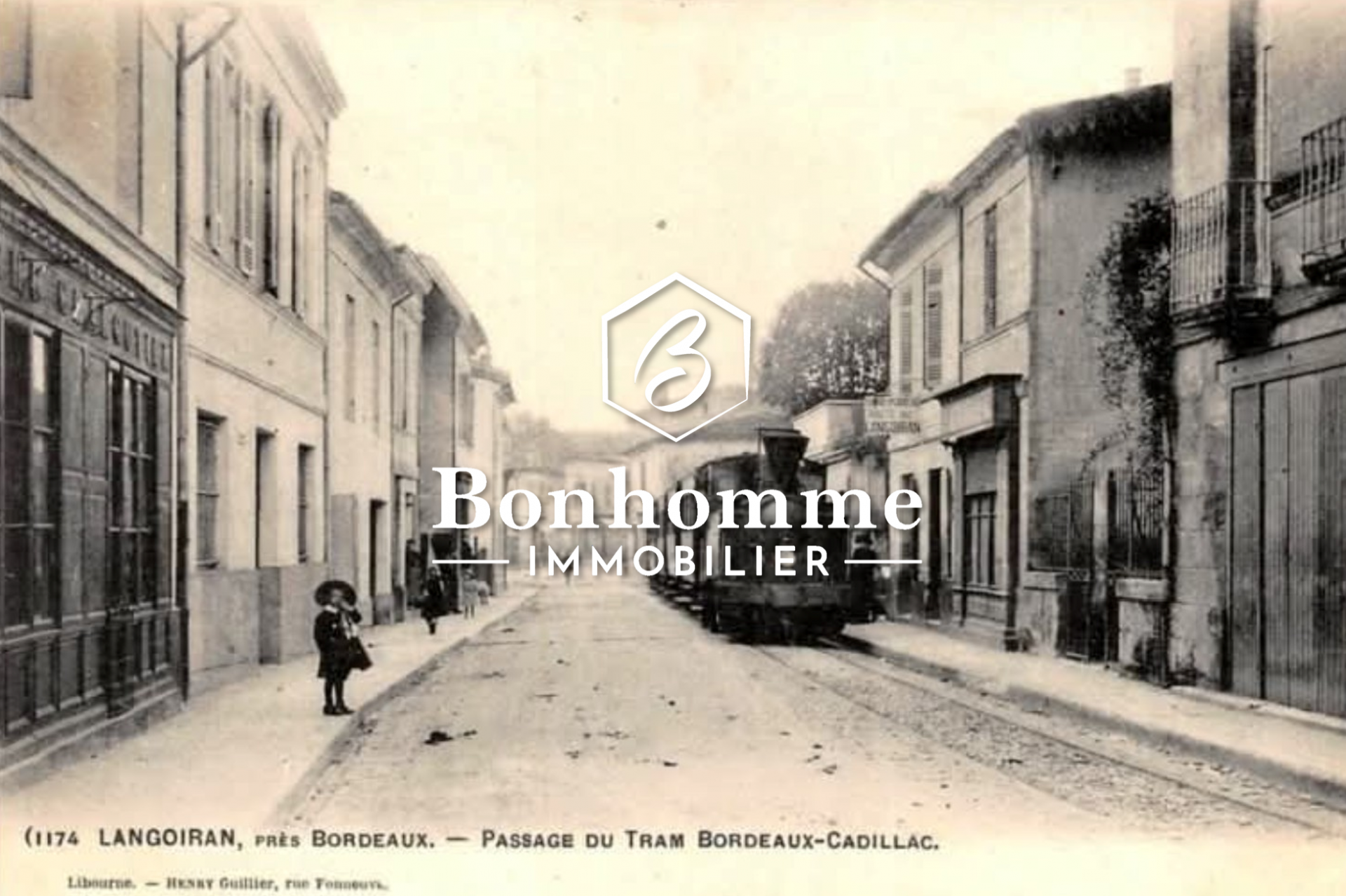
Old postcards of Langoiran: windows into village life
Before looking for a date or identifying a building, let us look at the people. In one photograph, a child stands beside a shopfront. In another, residents watch the tramway pass. Further along, a man poses beside his bicycle. These figures make the old views feel remarkably close: we recognise the places and discover the people who once lived there.
The images gathered here show streets shared by pedestrians, horse-drawn vehicles, early motorcars and railway trains. Shops open directly onto the pavements. Shutters, signs, awnings and steps create a familiar scene, even where some details have disappeared.
A postcard is still a carefully chosen view, sometimes a posed scene. It cannot tell the story of an entire day. Yet it preserves something precious: how a village presented itself, the activities it wanted to show and the places its residents could recognise as their own.

Photograph: old postcard no. 1174, “Langoiran, près Bordeaux — Passage du Tram Bordeaux–Cadillac”, Henry Guillier, Libourne.
The Garonne, at the heart of work and trade
To understand Langoiran in days gone by, we must return to the port. The municipality records a significant expansion in river trade during the eighteenth century. Locally built river barges, known as gabares, carried stone from the surrounding quarries and wine from the hillside vineyards. The river connected the area’s resources with their markets.
These goods give us a clear sense of the work involved: preparing cargoes, moving barrels, maintaining boats and organising arrivals. Around each vessel, a whole chain of activity linked the land, the workshops and the quays. Wine produced on the hills continued its journey on the water.
The heritage account published by Langoiran Town Hall also describes how craftspeople and shopkeepers settled around the port. A substantial part of village activity was concentrated here. The old façades therefore tell an economic story too, one of interconnected trades and the movement of goods.
The Estey: a small waterway with a place in local history
The postcard entitled “Le Tourne–Langoiran — Pont sur l’Estey” brings us closer to this life on the water. A boat with a mast fills the foreground; buildings line the banks; the bridge closes the view. Our eyes linger on the boat’s deck, the ropes, the banks and the windows and doorways of the houses.
It would be unwise to name this vessel without further documentation. What the image shows is enough, however, to remind us of the place of work in this landscape. The water reaches the foot of the buildings. The boat and the street belong to the same everyday setting.
The Estey bridge is recorded in the General Inventory of Cultural Heritage, which dates it to the third quarter of the nineteenth century. Its presence in an old postcard encourages us to look differently at modest structures: a local bridge can preserve the memory of countless journeys, far beyond its architecture alone.
Building boats: the craftsmanship of the Garonne’s banks
In Le Tourne, the Tramasset boatyards allow us to put names and dates to this history of work. Established in 1837, they built and repaired vessels. The French Ministry of Culture’s record of the boatyards mentions schooners, fishing boats and rowing boats, as well as the maintenance of canal barges and vessels from the port of Bordeaux.
The site was organised around these trades: workshops, access to the slipway, a sawmill and a steam chamber for bending timber. The Inventory records forty workers between 1870 and 1914. That figure reminds us that boatbuilding supported a community of workers and families.
These craftspeople deserve a full place in the history of Langoiran and Le Tourne. Their understanding of materials, joints and the demands of navigation turned timber into a working vessel. Honouring local heritage also means recognising this practical intelligence, passed on through years of learning.
The river barge Deux Frères: a story connecting both banks
One vessel illustrates these connections particularly well: Deux Frères. Its heritage record states that the original was launched in 1892 at the Tramasset boatyards for Jean Gergeret, the son of a bargeman from Portets. He transported wine and casks between Langoiran and Bordeaux until 1925. The boat we know today is a reconstruction completed in 1993, using elements of the original.
This documented history of the Deux Frères river barge gives river trade a human dimension. Behind each cargo were an owner, a crew, boatbuilders and customers. Behind each voyage were connections between Portets, Le Tourne, Langoiran and Bordeaux.
When the tramway ran through Langoiran’s streets
In several postcards, a steam locomotive makes its way between the houses. The Bordeaux–Cadillac tramway is one of the most striking images of our village’s past. Passing close to shops and pedestrians, this small train occupied space that we now associate with road traffic.
The municipality of Le Tourne confirms that the line opened in April 1897 and closed in June 1935. It carried passengers and goods along a route broadly following today’s RD 10. According to the same source, Le Tourne–Langoiran station was the most important between Latresne and Cadillac.
The historical account of Le Tourne’s former station provides these key details. The postcards bring them to life: carriages, rails, a locomotive and residents gathered nearby. They show how thoroughly transport was woven into the village landscape.
Travelling to Bordeaux, carrying crops and returning from the theatre
Journeys also served leisure and agriculture. The Mémoire Ferroviaire de Bordeaux association describes special services for celebrations and excursions, including a “theatre train” leaving Bordeaux at 12.30 a.m. on Sundays and public holidays. It also mentions peas being transported from the valley to the Capucins market in spring.
These examples make the line feel closer to us. The needs are still familiar: selling produce, reaching the city, enjoying an evening out and returning home. The tramway connected the villages to a wider world while passing through the heart of their daily lives.
Among the places served were Cambes, Tabanac, Le Tourne, Langoiran, Lestiac and Paillet. The line reminds us that each community belonged to a network of exchanges. Our local history can also be understood through the wider story of this bank of the Garonne.
Shops, the hotel and the post office: the faces of everyday life
Near Saint-Léonce Church, one postcard preserves a butcher’s shop sign. In other streets, awnings project above the shopfronts. The Grand Hôtel Saint-Martin has a covered gallery and a terrace where customers can be seen. These details bring history back to places of service, hospitality and encounters.
We do not know what these people were saying. We can, however, observe how closely different uses sat together: living upstairs, working on the ground floor, walking past a shop or stopping at a terrace. The photographs show façades that played a direct part in street life.
The postcard of the Hôtel des Postes, the post office building, offers another point of reference. Signs for the telegraph and telephone are visible on its façade. The mail itself accompanies us into the images: several cards bear a stamp, a postmark or a few handwritten words.
These traces add a personal story to the village’s history. Someone chose this view of Langoiran, addressed it to a loved one and sent it on its way. More than a century after some of these photographs were taken, that thoughtful gesture can still be read.
Church towers and bridges: landmarks of a growing community
Saint-Léonce’s church tower appears in the views of Langoiran; Saint-Étienne’s features in the postcards of Le Tourne. Distinguishing them respects the identity of each community while recognising their connections.
Saint-Léonce was built because the old parish church was far from the homes of port residents. According to the tourist office’s account of Saint-Léonce Church, its foundation stone was laid on 15 December 1854. The history of a building can thus reveal the changing needs of a neighbourhood.
Another landmark, the metal bridge over the Garonne, was built in 1881 by Fives-Lille, according to the municipality’s account. It connects Langoiran with Portets. Often called the “Eiffel bridge”, it reflects the metal construction techniques of its time. The municipality’s heritage overview recounts its origins.
Living with the river and its power
The Garonne offered opportunities for work and travel. It also demanded attention to the water. Its movement, the tides and the conditions of navigation belong to the history of its banks.
The mascaret, or tidal bore, is a remarkable expression of this. The municipality of Le Tourne explains the phenomenon: a rising tide sends a surge upstream, which can form a wave whose strength depends on factors including river flow and the shape of the riverbed.
A tribute to life in the past should keep this reality in mind. A beautiful postcard cannot show every hardship of work or every family’s worries. The past deserves more than a uniformly happy picture. Our attachment deepens when we also consider the effort it took to work, travel and support a household.
A heritage that continues to live
The shift from boats to rail, followed by the growth of road transport, changed local trade. Yet the traces of these activities can still enrich the way we see our surroundings. A street, an old building or a structure over the water becomes more interesting when we know what it was used for.
At Les Chantiers Tramasset, the association established in 1997 continues to pass on knowledge of woodworking, river heritage and local life. Visits and educational activities offer ways to explore this memory through the site and its craftsmanship.
This approach gives heritage conservation its full meaning. A photograph helps us recognise; a story helps us understand; a skill learned helps us pass something on. Each generation can find its own way into the history of the place it calls home.
Passing on Langoiran’s memory, one contribution at a time
Old postcards invite us to look more closely at our village. Anyone can help take this discovery further:
- Compare an old view with the same place today, looking at building shapes, windows, doorways and street alignments.
- Keep captions and the backs of postcards: publishers’ names, messages and postmarks can support further research.
- Record a family memory, noting who tells it and which period it concerns.
- Share a documented identification of a shop, a boat or a building.
A small detail can be valuable. A name restored to a façade, a date found in a letter or a trade linked to a family enriches our shared memory. We should also leave room for questions: the date a postcard was sent does not always tell us when the photograph was taken.
Living in Langoiran means becoming part of its story
A house preserves ways of living as well as materials. An old shopfront recalls a trade; a staircase connects generations; a window maintains a particular relationship with the street or the river. This dimension shapes the way we look at residential heritage.
At Bonhomme Immobilier, our attachment to Langoiran accompanies our daily work. We want to contribute to a better understanding of these places, with equal interest in their past and in the people who will bring them to life tomorrow. You can discover this local connection on our page about Langoiran and life in the village.
This tribute is for the residents, families, craftspeople, shopkeepers and people of the river. Their names are not all recorded in the archives. Yet the images preserve their presence. Looking at them, we rediscover a community shaped by work, exchange and attachment to place. A story that we, in turn, are fortunate to continue.
Frequently asked questions about Langoiran’s past
Did a steam tramway really pass through Langoiran?
Yes, the Bordeaux–Cadillac tramway ran through the village. The line opened in April 1897 and closed in June 1935. Several old postcards show trains passing through its streets.
Was the Garonne used to transport local goods?
Yes, river barges carried goods including wine and stone. The port, shops and boat-related trades played an important role in local activity.
Are Le Tourne and Langoiran the same municipality?
No, they are two separate municipalities. Their proximity and shared river history explain why both appear in accounts of the port and the tramway.
Does a postcard’s postmark give the exact date of the photograph?
No, it generally records when that particular card passed through the postal system. The photograph may be older; several pieces of evidence must be considered to date it.
Let us write the next chapter of this local story together
Do you have an old photograph, a family memory or a property project in our area? Come and talk with our teams. We would be delighted to learn about your connection to these places and help you with your plans.
Langoiran Agency: 35 avenue du Général de Gaulle, 33550 Langoiran — 09 73 26 77 81.
Saint-Selve Agency: 11 Grand Rue, 33650 Saint-Selve — 05 40 05 14 03.
Damien BONHOMME
Managing Director of BONHOMME IMMOBILIER and head of Groupe BONHOMME since 2011
A group specialising in residential, business and commercial property, property holding companies and investment in Gironde since 1991.